Sand on the move
Sand dunes
Sand covers only about a fifth of the world’s deserts. Where it does gather, it builds shapes that move, grow, and in a few places sing.
Five basic shapes
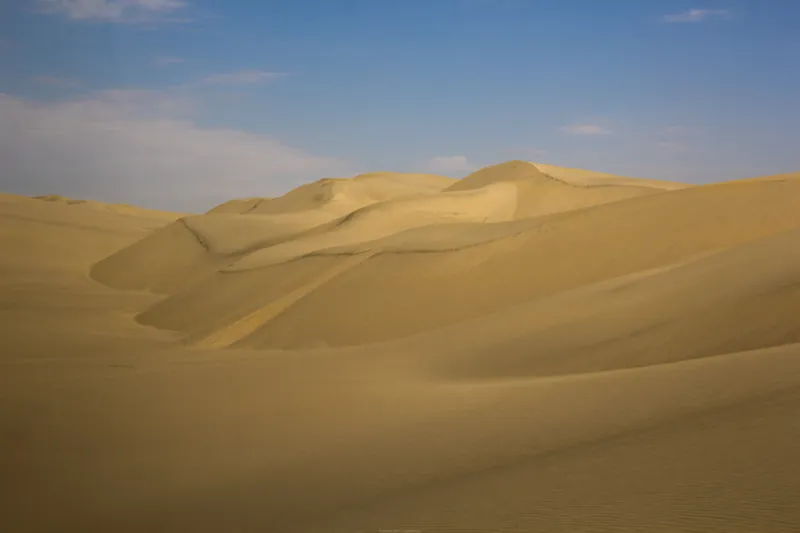
The USGS, using Landsat and aerial photographs, defines five basic types of dune: crescentic, linear, star, dome and parabolic. The crescentic dune is the most common on Earth and on Mars. These crescents form under winds that blow from one direction, are also called barchans, and some move faster over desert surfaces than any other type of dune.1
The Namib Sand Sea is one of the great dune fields: UNESCO calls it the only coastal desert in the world with extensive dune fields influenced by fog, and it covers more than three million hectares.2
Star dunes: young giants
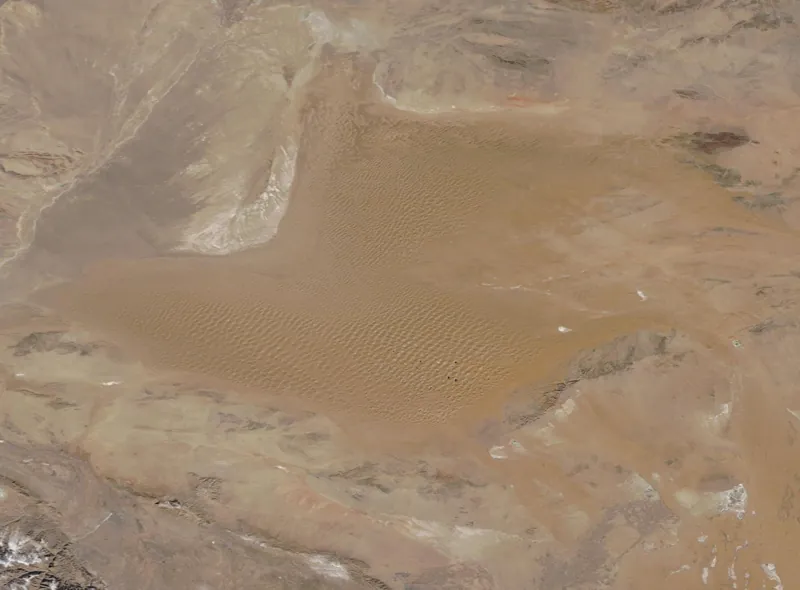
Star dunes, with arms radiating from a central peak, are thought to be the tallest dunes on Earth; one in the Badain Jaran Desert in China reaches 300 metres. They are also found on Mars and on Saturn’s moon Titan.3
In 2024 researchers dated Lala Lallia, a star dune in Erg Chebbi, Morocco. The oldest parts of its base are 13,000 years old, but most of the dune formed rapidly in the last thousand years, and it is moving across the desert at about 50 centimetres a year.3
Dunes that boom
A few dunes make a loud, low hum when sand avalanches down their faces. A Caltech-led study in 2007 measured one dominant audible frequency of 70 to 105 hertz, plus higher harmonics. It challenged earlier ideas that grain size sets the note: the frequency is fixed by the depth of a surface layer of dry loose sand, which acts as a waveguide.4
A note on scale: 300 metres is the height given for a Badain Jaran dune in the Aberystwyth announcement. The satellite picture above shows the desert from space, not that particular dune.