The desert on the wind
Desert dust
The Sahara does not stay in Africa. Every year a slice of it blows across an ocean, and some lands on the rainforest.
From the Sahara to the Amazon
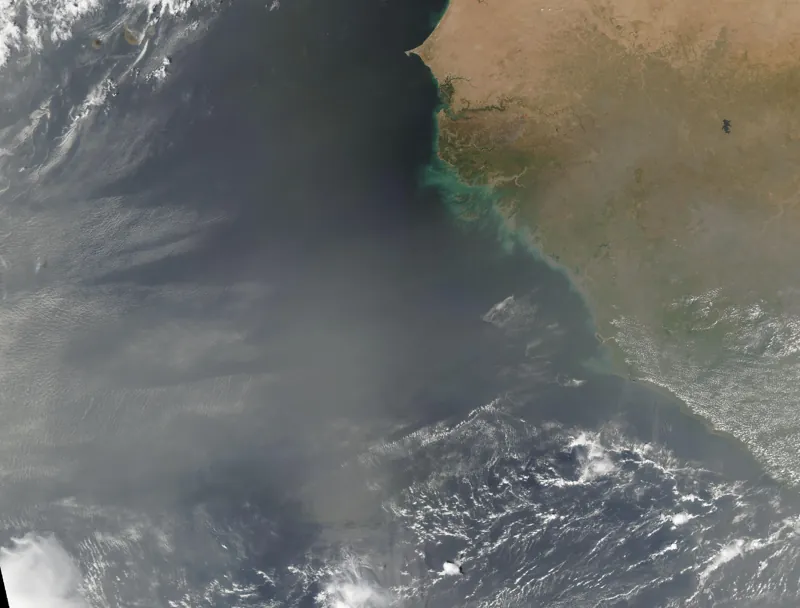
Using a lidar on the CALIPSO satellite, from 2007 to 2013, NASA researchers measured how much dust leaves the Sahara. On average 182 million tons a year are carried past its western edge. Near South America about 132 million tons remain in the air, and 27.7 million tons fall over the Amazon basin, enough, NASA says, to fill 104,908 semi trucks. About 43 million tons travel on to settle over the Caribbean.1
Fertiliser from a dead lake
What matters is what is in the dust. The Bodélé Depression in Chad is an ancient lake bed, and its minerals, made from dead microorganisms, are rich in phosphorus. The phosphorus reaching Amazon soils from Saharan dust, an estimated 22,000 tons a year, is about the same as the amount lost from those soils to rain and flooding.1 A desert, in other words, helps to keep a rainforest topped up.
Saharan dust in Britain
The Met Office says that when strong winds lift dust high over North Africa and the upper winds blow north, it can be carried as far as the UK. Once it is lifted, dust can reach very high altitudes and travel thousands of miles.2
“Blood rain” is not a scientific term, the Met Office says, but a colloquial phrase that goes a fair way back in history. It happens when fairly high concentrations of red dust get mixed into rain, and proper blood rain, where the rain really looks red, is relatively rare. In 2001, monsoon rains in the Indian state of Kerala periodically fell red enough to stain clothes.3
Tons, not tonnes: the NASA figures are in US tons, as published. We have not converted them.