When the desert was green
The Green Sahara
The world’s largest hot desert has not always been a desert. Its rocks and graves remember lakes, hippos and fishermen.
Hippos on the rocks
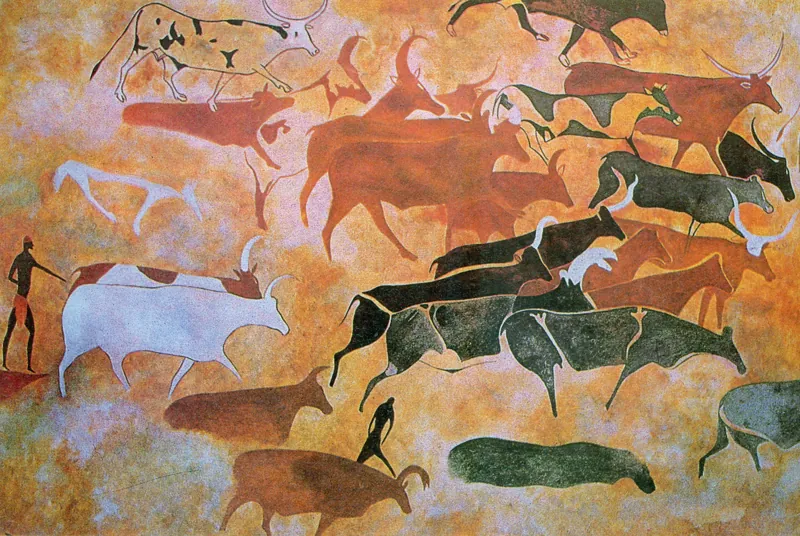
The Tassili n’Ajjer plateau in Algeria holds one of the most important groups of prehistoric rock art in the world. UNESCO counts more than 15,000 drawings and engravings, which record climate change, animal migrations and human life on the edge of the Sahara from 6000 BC to the first centuries of the present era.1
The art shows water-dependent animals such as the hippopotamus, and species that have been extinct in the region for thousands of years.1 A hippo needs water to live. Painting one in what is now the Sahara means the painters saw one.
Gobero: a graveyard by a lost lake
In Niger’s Ténéré Desert, known to Tuareg nomads as a “desert within a desert”, Paul Sereno’s team happened on the largest Stone Age graveyard found in the Sahara while hunting dinosaurs. They named it Gobero, after the Tuareg name for the area. It was full of skeletons of people and animals, including large fish and crocodiles.2
Two seasons of excavation revealed some 200 graves, from two lakeside populations separated by more than 1,000 years. The older people, the Kiffian, were tall hunters who speared huge perch with harpoons during the wettest part of the green Sahara, between 10,000 and 8,000 years ago. The later Tenerian people hunted, fished and herded cattle about 7,000 to 4,500 years ago.2
Their burials are personal: a girl wearing an upper-arm bracelet carved from a hippo tusk, and a triple burial of a woman and two children in an embrace.2
Dust from an old lake
The green Sahara left a souvenir that still travels. The Bodélé Depression in Chad is an ancient lake bed, and NASA says its dust, made of minerals from dead microorganisms, is loaded with phosphorus. Every year some of it is carried across the Atlantic to the Amazon.3 The story is on the dust page.
Kept labelled: dates here are as each source gives them. UNESCO gives the Tassili art “from 6000 BC”; the Gobero dates are years before the present. We have not converted between them.